Transcript
Auto-generated transcript. Not time-synced to the video.
In the beginning of the parashah,
parashat Vayikra,
Hakadosh Baruch Hu says to Am Yisrael,
that
each
one among us
to bring an offering to Hashem from
within themselves, mikem.
And Ohr HaChaim Hakadosh says, we need
to know why
the Torah has to say among you.
Well, the verse could have simply said,
when a man brings an offering to Hashem.
Another question is, why did it put off
saying among you until after
mentioning what is done by the person
that he brings.
It would have been more fitting for the
verse to first set out the full
description of what he's going to do.
What's the act?
Who it's clearly talking about.
When it says a man,
meaning that it should have finished the
phrase and said, a man among you.
And then mention that whatever is being
done by the person.
Meaning that we see that there's a lot a
lot more
into this than just a simple
meaning.
So, the first part, the Ohr HaChaim
Hakadosh says, Rabbi Chaim ben Attar,
is that
the sages teach us
that
they interpret
the of of you among you,
saying that this comes to exclude
the renegade Jew
from bringing the the
korban.
meaning the one Hashem says
when a man among you brings an offering
to me, to Hashem
he's not referring to the renegade Jew.
Now,
this is not every renegade
cuz there's a renegade and there's a
renegade. What's the difference?
Says
if the renegade
is rebellious
against the entire Torah
meaning he disregards all of the laws of
the Torah
or he's rebellious in regards to idol
worship which is equivalent to the
entire Torah
then he cannot bring a sacrifice.
The sacrifice is rejected.
But if he's a renegade
who's not rebellious against the entire
Torah
then his sacrifice is accepted.
So if he habitually disregards the
entire Torah or engages in idol worship
then
he's excluded from bringing a sacrifice.
But if he's a Jew that disregards only
some of the commandments but obeys
others
then he's allowed to bring a Kurban.
Now it seems
that this is
deep
and sufficient but it only begins this
way.
So you see
the same Torah that's talking about the
renegade Jew
is also talking about
bringing
a
sacrifice
bringing an animal.
Or Hayyim says,
the Torah is also trying to tell us
that even on the good side,
not just the rebellious Jews,
but even on the good side, there's
different levels
among the righteous.
There's
instructions
to men of of distinction, to righteous
Jews,
to do what?
To strive
to draw the hearts of other members of
the Jewish nation
nearer to the service of Hashem.
This is referred to as bringing an
offering
to Hashem.
For through man's sin,
a rift is formed
in the attachment between the Jewish
people and their father in heaven.
Of which it's written in the book of
Deuteronomy chapter 4 verse 4,
but you are attached to Hashem your God,
you are all life today. That's what
Moshe Rabbenu told us.
And the Jewish people become separated
and distant from the Shekhinah,
but Hakadosh Baruch Hu is upset
by this matter,
and he desires to draw them near him
once again.
And he therefore instructed the
righteous
to rebuke, to admonish anyone who is
distant from him,
and to draw that person's heart near to
him.
He prescribed a punishment for anyone
who turns a blind eye to this matter.
And this is your proof of the matter,
says Orach Chaim Hakadosh.
At the time of the destruction of the
first Bet Hamikdash, Hashem instructed
the prosecuting angels to begin the
punishment with the holy ones.
For although they themselves were
innocent of wrongdoing, they did not
protest against the acts of the sinners,
of the renegades.
As in the Gemara Maseches Shabbat page
55A.
And conversely, Hashem has prescribed a
great reward for a person who returns
sinners to him and causes them to do
good.
In accordance with the statement that
the Pirkei Avot chapter five, Mishnah
number 18 says,
"Whoever
brings merit to the public will not have
a transgression come to his way." This
is because Hashem will protect him from
his errors and in in reward for bringing
others close to him.
Now, how is this
interpreted into this
verse as far as the sacrifice?
Says the Orach Chaim,
"The Torah is particular to use the term
Adam,
which is an expression for a man
that connotes distinction, somebody
significant.
Like the Zohar Hakadosh says,
when he draws near and whom he draws
near,
the verse explains by saying of you,
meaning that some of the lowly ones that
are among you
who have rebelled against Hashem
and said, 'God, go away from us.'
And have distanced themselves from
attachment to Hashem, blessed be he.
That is who the distinguished man, the
Adam,
shall draw near.
And the verse says, "An offering to
Hashem." Meaning that the one who does
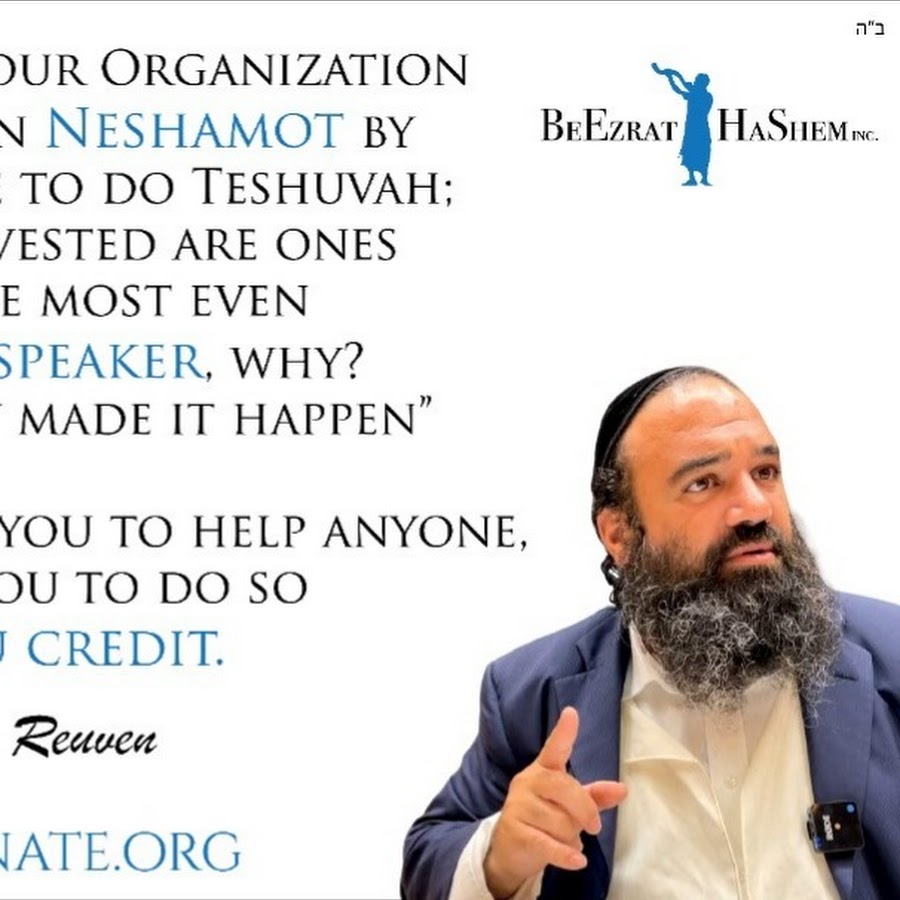
this, the one that does kiruv, the one
that actually helps people do teshuvah,
this is considered to be as a korban to
Hashem, as an offering to Hashem.
For he hereby brings a Jew who is a
shoot of Hashem's holy planting back to
its root.
Such a person doesn't need
a vowed or donated offering. He doesn't
need to bring regular korbanot like the
rest of the nation, even the righteous
ones, but they're not doing kiruv.
They still have to bring sacrifices for
their unintentional sins, but the one
that does kiruv, that brought even a
single soul to do teshuvah, he doesn't
have to bring any sacrifices
because he has achieved
the same thing by drawing a distant Jew
near to Hashem.
And therefore, there's no situation in
which he would have to bring a korban
chatat or asham,
which atones for unintentional sins.
Because as the sages taught us, "Whoever
brings merit to the public will not have
a sin occurred through him." Meaning
that Hashem will protect him from
sinning even in error.
And if someone does not it does not sin
unintentionally, then there's no need
for them to bring any sacrifice.
Here, rabotai kerim,
and he continues further, anyone wants
to look further into his holy words of
the Orach Chaim, it's
this week's parashat Vayikra, first
chapter,
in the second verse.
In so many words, the Or HaChaim
HaKadosh
is saying,
"Yes, we have rebels,
but there are different levels of
rebels.
Some of them
Some of them are the worst of the worst.
Some of them
join
the
church,
become the leaders of the church, become
leaders in
missionizing Jews
to try to bring them to idolatry.
And unfortunately, the most
popular and successful Christian
missionaries
are halakhically Jewish.
Some of the worst heretics
that the world has has today
are rabbis
or people that teach Torah.
Whether they tell you
one thing or the other, you're not even
sure which is true, which is false,
unless you're learned in Torah. And
unfortunately, many people fell.
So, those rebels,
those enemies of the Torah,
those versions of Esau that are
literally
trying to brutally destroy the Torah,
they cannot bring a sacrifice. They
cannot atone for what they did. They
simply are enemies. They They have no
interest in ever changing.
But then there's a different type of
rebel.
A rebel that is simply ignorant. A rebel
that is simply addicted to drugs,
addicted to immorality, addicted to
money, addicted to all types of other
things, and simply ignorant about the
consequences
of what happens if Hashem
punishes him.
That rebel
Hashem wants him back.
Hashem wants him back and is waiting for
him or her
every single microsecond.
When are they going to say Shema
Yisrael?
When are they going to come to shul?
When are they going to learn a little
bit of my Torah?
When are they going to do another
mitzvah?
When are they going to say
that I am the only God?
When are they going to say I love you,
Hashem?
When are they going to be afraid that
I'm going to punish them?
When?
Every day.
For thousands of years, Hakadosh Baruch
Hu has been waiting for that soul to
come back to him.
>> [clears throat]
>> Looking for him in every corner, waiting
for him in every second.
Imagine a father
waiting for his long-lost son that he
knows is alive.
And the only way for him to see him
again is if the boy or the girl comes
back home.
There's no end
to the agony of the father.
As Yaakov Avinu could not stop crying
over Yosef.
Hakadosh Baruch Hu
waits for every rebellious Jew to come
back home, to stop violating Shabbat, to
stop being in a corrupt business, to
stop being corrupt in every aspect.
But he can't force you to come home.
But he can send messengers to get you.
So, when there's a messenger that goes
and makes the sacrifice
and makes the effort
to go find one of Hashem's children to
bring him back home.
Imagine
the extraordinary
nachas that you bring to Hashem that you
brought one of his children back or 10
or 100 or 1,000 or 10,000 or more.
Imagine the reward that the messenger
would get from the king.
Even if the king was a flesh and blood
king,
lowly flesh and blood of today, imagine
what he would give a messenger that
found his son and brought him home.
Needless to say the king of kings,
with no limitations, no concept of of of
time, no before, during, or after,
imagine the reward that Hakadosh Baruch
Hu will bring
and give to that messenger
that brought one of his children back.
Imagine
the punishment and the wrath
that the
so-called Erev Rav,
wicked
enemy,
that told
that person not to do teshuvah,
that person not to follow
what the Torah says, but rather to
follow a different path,
a path of heresy, a path a path of
addiction,
a path of foolishness.
When that boy was on the way home,
unfortunately there's been a lot of boys
on the way home
that have been kidnapped by
even worse monsters than the ones that
originally took them.
>> [music]
>> That's a fortress I used to go to every
morning bend over
in the toilet. I don't know if they let
you stay in the bathroom or not. I don't
know if they let you stay in the
bathroom
or not. I don't know if they let
Amen.