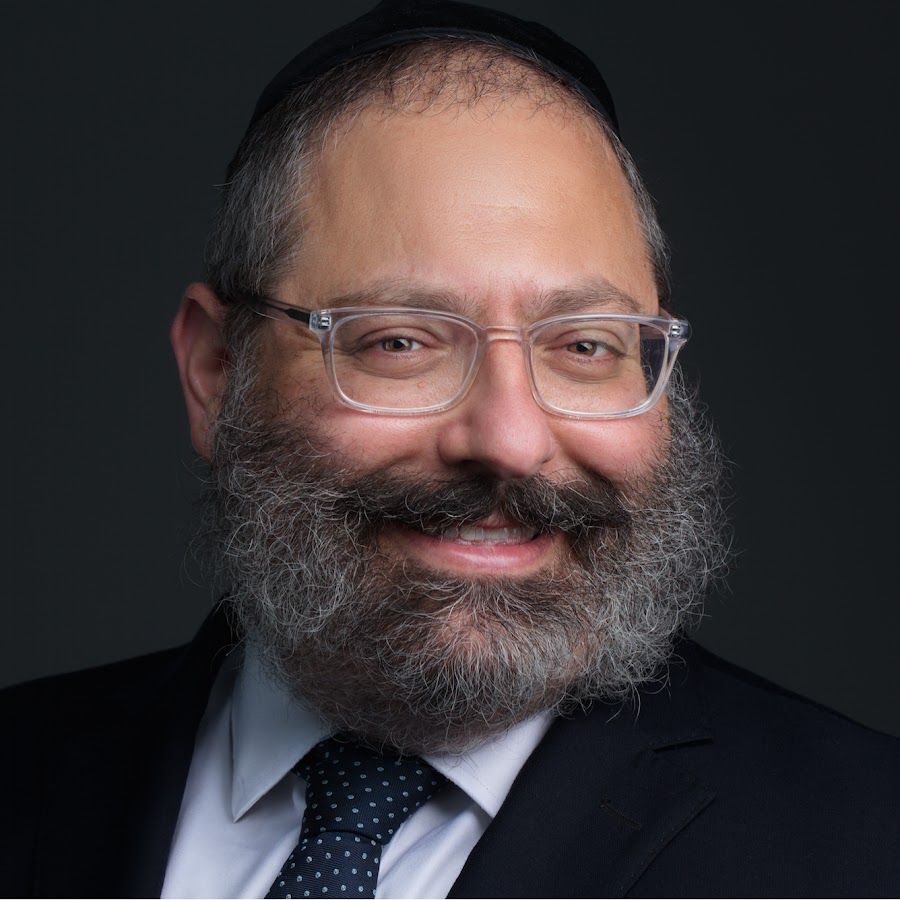
Auto-generated transcript. Not time-synced to the video.
The Yeshiva.net
Okay, welcome back to the Meaningful
People podcast. Right? Right. Right.
What a guest this week. Rabbi YY
Jacobson, it's a biggie. Yes. Yes. Big
scoop alert. We got an incredible guest.
Rabbi Jacobson welcomed us into his
humble abode, his home in Monsey, New
York. Right on his porch.
Right on his porch, outside.
as possible with
One fact, started raining at the end,
but don't worry.
Hashem got us covered.
Not really, kidding. It rained. It
rained, but Hashem got us covered. It
did, but we're good. We're good. The
equipment was great. Sruly Saftler did
an amazing job taking care of us. Um,
but this episode is deep. We talk about
some really, really
strong topics that Rabbi Jacobson excels
in discussing all over the world.
He really needs no introduction, no?
Yeah, no, he really does not.
One of the most captivating
personalities in Klal Yisrael. It was an
incredible conversation. We sat down.
The positive energy and just his view on
so many different issues that some
people might look at negatively, somehow
he sees everything with such a positive
light. And he just really sheds
incredible light on everything. That's
Rabbi Jacobson, and you'll get to this
episode. But just wanted to give a big
shout out besides for our friends at
Bridge Credit Solutions
and Touro University,
we have our friends from Machshavous
Yichezkel. If you get to spell that, you
get a free like row at the same as Shas,
I think, if you know how to spell that.
But right over here there's a product of
an image, Machshavous Yichezkel, a big
talmid chacham, Rabbi Yichezkel Hartman,
who actually lives in the Five Towns.
And he actually posts every single day
halacha on the Meaningful Minute app. He
has something called Machshavous
Yichezkel. Yeah, big talmid of Rav Moshe
Shapiro, and really delves a little bit
deeper, a little bit more meaningful
perspective on some of the Torah that we
might have learned very quickly in
Yeshiva. Maybe we didn't unpack the
aggadata, it's a story, we're not sure
exactly what's going on, and he takes
that depth, that pnimius, that
meaningful approach to every aspect of
the tire including Agata to Gamoras. So
you can go ahead and actually search
that on any podcast platform or you can
just go to machshavasyitzchok.com.
It's available on WhatsApp, it's
available on all daf, it's available
literally everywhere. So go ahead,
machshavasyitzchok.com
and enjoy this episode with Rabbi
Jacobson.
You are listening to the Meaningful
People Podcast, the podcast featuring
our nation's most impactful, influential
and meaningful people.
Rabbi Jacobson, thank you so much for
hosting us beautiful home. Thank you.
This beautiful back porch
which
I know in October has a nice beautiful
sukkah out here with decorations, but
nonetheless it's beautiful right now, so
really appreciate you taking time out of
your busy schedule and sitting down with
us, really. My pleasure, my honor.
No more, what do you say?
Welcome to my four cubits here. Yeah,
it's very nice, beautiful. It's really
incredible to be here. We're in
beautiful forest, so if you ever want to
come to meditate.
Despite of this, is that what the is
that what the Rav does? Step out into
that forest over there?
Sometimes when I have to think for a few
minutes, it's a good place to think.
Right, right. Can't overthink, but you
know, sometimes it's good.
you have quite a few children, how many
children quite a few children, how many
children do you have? Seven. So you need
to step out to think sometimes.
Sometimes. Thank you to your wife and
seven
actually you have to learn to stop
thinking.
Sometimes you have to think. Thank you
to your wife and seven children for
allowing you to sit with us during a
hectic time, might be bedtime.
Thank you, my pleasure. Absolutely. So
we wanted to to start by talking I've
heard you describe your role within the
ecosystem of Yiddishkeit as an
ambassador of infinity.
And you know, with the luxury of not
having to you know, pursue any
institutional goals, you really are an
independent.
And to be able to be an ambassador of
infinity is uh
it's a mighty big ask. And we'd love to
hear how you how you see that role, how
you execute that mission.
Ambassador of infinity is uh quite a
title.
Because by definition, an ambassador of
infinity means you can't have any titles
because infinity
defies any description
or definition or space or time.
I think maybe a more appropriate way of
saying it would be
that each and every one of us is an
ambassador of infinity.
And uh
what I try to do with my life, at least
part of my life, is
to help empower people
and be able to uh
help them and myself and all of us
become more cognizant
of how much we are capable of being
ambassadors of infinity.
Because I think that in today's
generation
the greatest uh
challenge, or at least one of the
greatest challenges that so many people
have,
is not the challenge of pure evil or
negativity or
self-centeredness
or laziness or the old classic yetzer
hara that has bad middos.
But I think the biggest challenge today
is that people do not realize their
inner wholeness. They don't realize that
they're ambassadors of infinity.
We uh easily fall prey
to uh
our toxic voices
that deprive us from our ability to
truly shine and be the person who we
really are. Is is that how we as humans
are sort of hardwired? Is there
something that happens to us that makes
us that way?
Or
what what do you think it is?
I think every generation has its unique
challenges and its unique opportunities.
It seems to me that in previous
generations, people's egos were much
healthier. Really? Yeah, I'll give you
an example. Okay?
I grew up with Russian parents. My
father grew up in Russia, my father of
blessed memory, and he loved Pushkin.
Pushkin
was a non-Jew. He was considered the
greatest Russian poet. The greatest. And
my father was a very cultured man, and
he knew very well Russian literature and
history and poetry. He loved repeating
Pushkin's poems.
And uh
his name was Alexander Pushkin.
And then I once asked him, you know, who
was Pushkin? When did was he born? When
did he die?
Uh he lived in the 18th and 19th
century.
So, he died in his early 30s from a
duel.
From a duel.
And my father was sharing with me how
some of the greatest talents in the
ancient world, a man who was the
greatest poet in the country.
So, he was a literary genius. But he
died to save face. Somebody called you
out for a duel,
and you simply died for a fight. So, a
duel is old old term of saying he he he
threw fist. He got in a fist
basically for your dignity you were
ready to die. Wow. You know, people
today were ready to die for their
dignity.
The the the sense of self seemed so
powerful.
That's what it seems to me. I don't
know, maybe I'm wrong. Today you really
see that. Why? What happened?
I think on one hand
there's I think
there's maybe a certain humility after
so many generations
of trials and tribulations and
persecutions
and trauma, there's a humility that set
in. And uh I don't see today the problem
as people having big egos. I think every
big ego you see today
is is just a manifestation of profound
insecurity Mhm.
and profound fear.
Um I once heard from the Lubavitcher
Rebbe,
he said that the yetzer hara of this
generation is
four words, "Mi ani? Omani?"
The sense of who am I and what am I? I'm
a shmata. I'm a doormat.
I'm a rag. I'm a nobody.
Am I really capable? In his words,
"Do I really think I'm capable
of being a home for the divine presence
or as you call it infinity? Not me. You
know what I was You know what I did
yesterday? You know what I was thinking
about an hour ago? If you would just
know He said, 'If you would just know
me, you would know that it's not even a
question. I'm so unworthy and
inadequate.'"
And in many ways it's it's I think the
yetzer hara of today's generation, at
least a big part of it.
I think we'll delve into that a little
bit further and dissect it um because I
think there's so much
to learn and everyone who's listening,
I'm sure, can resonate with what you're
saying. But I want to like sort of
uh rewind a little bit on on your life,
Rabbi Jacobson.
Um what was what was your upbringing
like? What was your childhood like?
I I'm assuming you weren't
um
you weren't born this inspirational
talmid chacham who's just speaking all
over the world.
says in Niddah that every child every
fetus is in the womb of its mother
gets to learn the whole Torah. So I was
wrong. You were a lot holier You were a
lot holier than then.
born that way, but you were also born
that way. We were all born that way.
That's the The difference between males
and females is that males, when they're
born, they forget the Torah. And females
don't forget it. Mhm. Nice. That's why
we make a simcha for males, not females.
So then I think we're all There's
there's a beautiful uh
beautiful word from the Chidushei Harim,
the first Gerer Rebbe.
Reb Yitzchak Meir Reb Yitzchak Meir
Alter was his name.
So he once said, it says in the pasuk
Mishlei, "Shma beni musar avicha v'al
titosh toras imecha."
Listen to the rebuke of your father and
don't neglect the terror of your mother.
She said why by your father is it rebuke
and by your mother terror and why your
father do you have to listen to the
Musser and your mother just says don't
I'll teach us don't neglect it.
So he says the Musser of your father is
what your father teaches you as you're
growing up. The terror of your mother is
what you learned in the womb of your
mother.
So you have to listen to the rebuke of
your father but I'll teach us
You don't have to learn it. It's in you.
Just don't let go of it and it's not
Musser. It's terror. It's
as I tell my students what I think the
condition is really saying. How do you
know you're listening to terror?
When you hear a sheer or a lecture and
insight or anything you hear how do you
know it's terror?
The answer is if you heard it already.
If it resonates. Doesn't mean that it
doesn't challenge you. It may challenge
you very deeply. It should challenge
you.
But if it's real terror you knew it
already
cuz it's organic. It's made. It's
intrinsic. I know it from the womb of my
mother.
That's in terms of my birth.
In terms of our birth I should say.
But then we forget things after we're
born. Goes downhill.
So
I grew up in
the Crown Heights section of Brooklyn.
There's a hospital called Lefferts
General Hospital. I remember the name
because today it's a big
girl's school. It's called Campus
Chomesh Bais Rivkah.
But that used to be a hospital so that's
where I was born. So I was literally
born and bred in in Brooklyn. Both of my
parents were immigrants from the former
Soviet Union.
My mother comes from a Ukrainian Jewish
family. Ukraine is quite famous today.
And then they fled to Georgia South
Russia because of the communist
persecutions. Georgia was a little easy.
It was easier to live in Georgia as a
Jew because Stalin was from Georgia so
he was a little easier on the Georgians.
Really?
My father his parents came from his
family came from Georgia. Our name is
really Yakubashvili, which is a Georgian
name. I remember hearing that.
Yakubashvili. Yes, so Jacobson is really
a
Which generation changed that?
Well, my grandfather came from a place
called Kutaisi, Georgia. His name was
Simon, Simon Yakubashvili. Classic
Sephardic Georgian name. Wow. My brother
is named after him. My brother Simon
Jacobson, who you had on your show. Yes,
and that's where I'm remembering this
from. Yakubashvili. So my brother and I
share the same family name. Simon
Jacobson is
Yakubashvili. The same family secret.
It's not Jacobson. Yakubashvili means
Yacob is Jacob and shvili is son.
Right, right. I was once at a lecture
and I said it was Georgian Jews. I said,
you know, my name is Yakubashvili. I
wanted they should like me. Yeah. He
said, "What type of name is that?"
I said, "It's the name of every single
Jew. Aren't we all sons of Jacob? I
think, right?" Benai Yacob, Benai
Yisrael.
So and he left Georgia. He lived near
near Moscow. So my father was born in a
place called Mamontovka near Moscow.
They suffered a lot in the Soviet Union
and after the Second World War, Stalin,
Yemach Shmo who was the
undisputed dictator of the Soviet Union
for 30 years from 1924 till 1930 till
1953 when he died, he allowed Polish
citizens who escaped to the Soviet Union
from Hitler to go back to Poland.
So they forged passports and feigned
made themselves Polish citizens and many
families got out of the Soviet Union. So
they left in 1946
and they ultimately came to Europe and
the United States of America. My parents
got married in New York and they built a
family.
We're five siblings and I'm the baby of
the family.
Really? And my father was all of his
years a journalist, a very seasoned
Jewish journalist. Remember this is the
days before the computer, before the
internet, before WhatsApp, even before
Meaningful Minute. What? Those days.
But my grandfather worked very closely
with your with your father. So there's
some sort of
grandfather, whose name was Reb Nissan
Gordon, was also a seasoned journalist.
He was a Torah Vodaas student. He was
born in Dokshitz, Poland.
His father was a shochet in Dokshitz.
There's one of the most beautiful Chabad
niggunim is called the Dokshitzer
niggun.
Yeah, but every simcha we have that
niggun.
Beautiful, beautiful song. I love it.
So your your grandfather
sing it for us now. Yes.
If you didn't start it off, I don't know
if I I don't know if I feel it.
niggun. It is.
My my my Dokshitz family WhatsApp group,
right when they hear this, it's going to
just blow up. It's amazing.
Yeah, it's it's a very
It's a niggun of introspection,
of conviction, and of triumph. Mhm.
Dokshitz was a was a city,
but it was filled with very high-quality
Jews, very serious, genuine Jews.
The rav was a Jew named Reb Leib
Shainen, who was beheaded by the
Germans.
Your great uncle great uncle shared with
me the last moments of Dokshitz Jewry
because a survivor
a survivor came to America, and he told
your grand your great grandfather, Reb
Yisrael Yitzchak on the whole story. He
was already living in America. Anyway,
so your grandfather Reb Nissan worked
very closely with my father for decades
in the Yiddish press.
They worked on a newspaper called the
Day Morning Journal,
the Tog Morgen Journal, which was a
Yiddish daily.
People don't realize what Yiddish was at
the time. The Forward, the Forverts,
which was a leftist Bundist newspaper,
had a quarter of a million readers. A
quarter of a million Yiddish newspaper,
a daily. Daily wow. A daily newspaper.
It was the Jewish New York Times. A
quarter of a million readers, all Jews,
Yiddish. This was their ticket to
America. Does does like the New York
Times even have a quarter million
readers nowadays? I mean cuz like the
the industry has evolved so much.
but some people don't understand what
the Yiddish press was. The The power of
the Yiddish press to shape the Jewish
future was beyond our imagination. Today
every community has a newspaper. Every
house has a newspaper today.
Yeah. Every person with a computer
produces a book and a Haggadah. Yeah.
Right? Every shul has a newspaper. Plus
WhatsApps and everything else. But then
the newspaper business really defined
it. It It was really
was the oxygen for so many Jews.
My father found it very exciting. He was
the correspondent of Israel's largest
daily Yedioth Ahronoth in United Nations
and New York. He worked with Elie
Wiesel.
And he worked in the Yiddish press. He
worked for the New York Herald Tribune.
He worked for Newsweek. And he worked
for this daily Yiddish, The Day Morning
Journal.
And it closed down in '72. It just shut
down one day. The publisher just closed.
He didn't even warn them. Wow. And
that's when my father, a few months
later in 1972, opened up a Yiddish
weekly called the Algemeiner Journal.
And he got a group of tremendously
talented Yiddish writers.
Many of them were not religious. Some of
them were left-wing. Some of them were
right-wing. And one of the greatest
talents was your grandfather, Reb Nissan
Gordon. And they worked together for
decades until your grandfather's passing
in 1989, Hanukkah. And your father
didn't censor what the My father was so
allergic to censorship.
But not just allergic. He despised it.
And there was a reason for it. He grew
up in the Soviet Union. the Soviet
Union. And he didn't just grow up there.
They suffered terribly. His father was
arrested during the purges of 1938.
Stalin murdered between 20 and 50
million people. He killed more people
than Hitler.
People don't realize how many people
Stalin murdered.
Wow.
In 1938, Stalin
did committed the famous purges.
Almost everybody was arrested. Either
you were shot immediately, you were sent
to the gulag, you died in Siberia. And
my grandfather was arrested Friday night
and he was sent to prison. He was
sentenced to death. And then his
sentence was commuted to 25 years in the
gulag.
And my father was a 4-year-old boy. In
the middle of kiddush, his father was
taken away and he hasn't seen him for
years. He actually made it out. He made
it out. He came out of prison and he met
my father and he met his wife. Wow.
My grandmother and they made it out of
Russia. He died early. He died in '53 in
Toronto, a young man.
But my father, because of that, had this
uh He didn't want to censor anything.
deep deep
uh
negative feeling towards anybody who
censored views and censored opinions.
So, his newspaper was interesting cuz he
would allow
every voice and the voices were very
paradoxical. You know, you had from one
extreme to another extreme. So, it was
actually it was a very colorful
newspaper.
And yeah, I knew your grandfather very
well. He also lived one block away from
us on Montgomery Street in the Crown
Heights section of Brooklyn. So, he was
really um
an indispensable part of my uh
upbringing.
So, much so, speaking of censorship.
So, you know, like this is a good segue.
That's the juicy stuff, censorship. I I
I was thinking about about this topic
and then and uh speaking to people close
to me about this conversation that I'm
going to have with with you tonight.
Um there's a question on a lot of
people's minds. Um
there's this big movement nowadays with
Hasidus where
just because someone grew up not
Lubavitch or not Breslov or not Satmar
or whatever it is, they are connecting
to Hasidus. If you see the Five Towns
nowadays,
there are shul shudises and love of
Malkas that are just amazing.
But in our mainstream yeshivas and and
the schools that teach our children,
Pnimius HaTorah is not it's not taught
there. It hasn't been introduced into
the curriculum.
Why is that? And do you think that maybe
it will change?
It's a great question.
Listen, I think the curriculum of most
Yeshivas has been established
generations ago.
And many of the Yeshivas, at least in
the Lithuanian world, follow the model
of Volozhin, Mhm. which was built by Reb
Chaim Volozhiner. And even though he
himself, he himself was a student of the
Vilna Gaon,
and he writes that the Vilna Gaon, who
is the father of Lithuanian
Yeshivas and Lithuanian learning in so
many ways,
learned spent more time learning
Kabbalah
than learning Halacha, more nistar than
nigleh. And Reb Chaim Volozhiner himself
was an incredible Kabbalist. You could
see it in his work, Nefesh HaChaim, and
in his work, Ruach Chaim.
And besides being a great Halachic
Halachist, he was also a great
Right. Kabbalist. But the curriculum of
the Yeshivas in the Lithuanian world was
based purely on Gemara.
And more Gemara and Poskim. So, I think
that, you know, that created the
trajectory of the Yeshivas in one form
or another. The Yeshivas in the
Chassidic world
also introduced a little bit of
Chassidus, but also based on how much
they learned in those communities, cuz
even in the Chassidic world, not in all
the communities did they learn a lot of
Chassidus.
Right. The exception was the Chabad
Yeshiva created by the Rebbe Rashab, the
fifth Lubavitcher Rebbe, created a
Yeshiva in 1897,
tough freshman and 1897 in a little town
called Lubavitch in Belarus. And based
on the Chabad system, he introduced 3
hours
of learning Chassidus every day, an hour
and a half before davening, 7:00 till
8:30 in the morning, and then at night,
8:30 till 10:00. But from 10:00 in the
morning till 8:00 in the evening, it was
all Gemara. Just like the Litvish
Yeshivas.
But he put in 3 hours of uh Literally
extracurricular activity.
Literally extra early in the morning and
late at night.
Uh but the whole day from morning till
evening, it was Gemara, Gemara and
Halacha, Iyun Bkius, you know, this
similar to the Litvish Yeshivas,
actually.
And the reason was he felt he felt that
the dark days of Russia coming. He said
this clearly. He write He wrote a whole
book little about it. And he felt that
uh the new nisyoynis, the challenges of
a new generation um the youth is going
to have to have a much deeper uh
appreciation of a Judaism that's much
more sophisticated
and much more profound in terms of
emotionally, psychologically,
spiritually, intellectually. And he felt
that Torah Samach B'Nistar can provide
that. can provide that.
I think what we're what we're seeing
today is really a sign of Geulah.
Because who are the two greatest
Halachic authorities the two greatest
Nigleh authorities in Judaism?
I think most people would not dispute
Rashi and Rambam. Okay. Okay. Both of
them say something very interesting.
Rashi writes in the beginning of Shir
Hashirim that what Mashiach is going to
do is he's going to reveal to Klal
Yisrael Sod Ta'ameha u'Mistarei Torah.
The secrets of Torah.
The Rambam finishes his entire Mishneh
Torah with these words. That when
Mashiach comes, Lo Yihiyeh Esek Kol
Ha'Olam Ela Lada'as Es Hashem Bilvad.
U'Lefichach Yihiyu Yisrael Chachamim
Gedolim V'Yodim Devarim Astumim,
V'Yasigu Da'as Bore'am K'Fi Koach Adam
U'Shnei Ha'Olam K'Mo Lo Hayu Esek Kol
Ha'Olam Ela Lada'as Es Hashem L'Vado.
Basically, the Rambam is saying that in
the time of Geulah, the whole world, not
just the Jews,
the entire planet, all of humanity will
be immersed in one thing, divine
awareness. The Jewish people even more.
So, I think basically, as we get closer
and closer to Geulah,
there is a divine consciousness that
fills the universe. And the Jewish
people
who were sent to the world as
ambassadors of God, ambassadors of
infinity,
are the first ones to be sensitive and
and curious and thirsty for it. And
that's what we're seeing. How it's going
to affect the curriculum of the Yeshivas
Well, why why I mean why why not? Like
why isn't why
if what you're saying is it's it's being
introduced so much nowadays in in all
different communities,
why And the truth is even in most
Yeshivas, you know, I think
most Mashgichim or Rashei Yeshivas will
often uh
introduce consciously or unconsciously,
deliberately or non-deliberately,
naturally or by osmosis, uh so many
ideas of Torah and Nistar and Pnimiyus
HaTorah, um
you know, the division of of of the
olden days, I don't think exists
anymore.
In in terms of making it official
curriculum of Yeshivas, I think it's
going to take a few courageous uh people
to do that. It's hard for a lot of
people because, you know, we have this
idea of uh
Sure. you know, just
Sure. Let's see B'Ikvei HaMashiach or is
this a Mashgichim
The Vilna Gaon himself, the Vilna Gaon
himself writes, this is what he He
clearly writes this.
He says that uh
it's going to be the
spreading of Torah and Nistar that's
going to bring the Geulah.
He even says that in before Kriyas
Shema, Ahavas Olam or Ahavah of Ahavas
Olam or Ahavah Rabbah, depends which
Nusach you daven. So, he says "Veseim
libeinu binah l'havin ul'haskil ul'shmoa
ul'lamed ul'lameid." We ask Hashem for a
bracha for learning. But then after that
we say "V'haer eineinu b'Torasecha."
What you just asked for learning. So, he
says "Veseim libeinu binah" that's
Nigleh.
"V'haer eineinu" open our eyes, that's
Nistar. And over there it says "V'haer
eineinu" right? And then "V'haveiyenu
l'Shalom me'arba kanfos ha'aretz"
because it's through that light that the
Google consciousness will be introduced
into the world.
So, I think that, you know, we're
talking about the ultimate revelation of
the depth of Yiddishkeit
that belongs to all of Klaal Yisrael.
Maybe one fundamental misunderstanding
could be that some people think it's two
separate
uh dimensions. There's the world of
Nigleh and there's the world of Nistar
for a few Kabbalists, you know, maybe
over 40 or very spiritual people and
there are a lot of learn that. That's
how it was seen for many generations.
The truth is, the Vilna Gaon writes this
in three places in his safer on Mishlei,
as a commentary on Mishlei, three
places, besides in the Chassidic works,
that it's really you're talking about
one Torah, Torah Achas, it's one Torah,
it's like a body and a soul. They're
indivisible.
Every Halacha is a physical incarnation
of a spiritual idea and every spiritual
idea is manifested in the physical
concrete Halacha. It's not It's like
I'll ask you, where's your body and
where's your soul? Tell me, where does
your soul begin and where does your body
end?
Uh if you're a living person,
your body is a manifestation of your
Neshama and your your Neshama flows
through the body. So, really Yiddishkeit
is is holistic and I think we live today
in a time where uh
we we see how meaningful it's for people
when when people are given a Judaism
that is really holistic. They say we
Somebody once told me, Halachic and
mystic, Halachic and mystic is holistic,
holistic Judaism. It's the guf and the
Neshama together.
It's It's just it creates a different
level of of animation, of vitality,
of enthusiasm. People are not content
today with just, you know, robotic
ritual. They need much, much more depth
and excitement. Something that fills me
physically, viscerally, psychologically,
emotionally, spiritually. There's also
one more element that a lot of people
don't realize. And that is in the
secular world, in the non-Jewish world,
the cutting-edge revolutions in science,
physics, quantum physics, cosmology,
therapy, healing, psychology,
philosophy,
neuroscience are so profound and
incredible
that basically the language of
mathematics and physics and healing is
changing today into a spiritual
language.
Mhm. And if Judaism
does not compete on that level
for so many intelligent enlightened
people,
it easily becomes obsolete and
irrelevant. And I see it constantly.
Jews who had an education
and then they open themselves up to
what's available Wow.
and Judaism is almost like it's very
sad, it's archaic. And the only way the
only way to really deal with that is
if you study the writings of the Bal
Tanya, for example,
that he wrote 250 years ago. I've had
people sitting in my classes,
you know, from the secular world who are
at who are at the cutting edge of
science, physics, especially
neuroscience.
And one guy once jumped up and said,
"How did he know this?" Because in
Pnimius Hatorah, you have the spiritual
DNA of creation. When you have the
spiritual DNA of creation,
it's just a whole different dimension
that reveals the infinite depth of
Yiddishkeit.
So, I want to double click on on
something that you mentioned before
addressing, you know, what's competing
out there with all the developments in
the secular world, but that craving that
the products of the Yeshiva system have
for a deeper
you know, a deeper meaning within
Yiddishkeit from what they might have
been offered within the Yeshiva system.
Let's Let's help people navigate this
tension, this struggle where they've
been through the oilam Yeshivas. They've
They They were completely immersed in
it. And it was it was an amazing stage
of their life. Now they find their self
themselves craving more.
And a lot of a lot of what they consider
to be more is available to them in
different mediums and they can find it
online and they can find content that is
resonating with them.
But they might feel like they have to
let go of everything that they've been
taught and that they've become familiar
with until that point. And it's very
confusing for them because they had an
amazing time in Yeshiva. It was it was
an incredible development of their
person.
And they feel like they have to let go
of that to embrace something else and
they don't want to have to let go of
something and they want to reconcile it
and they want it to all be consistent.
But how do they do that? Excellent
question. And that's fearful. It's
fearful and it's also uncomfortable.
And it also seems like a betrayal of uh
of so much holiness and so so much
goodness.
So I'm going to share with you an
insight of the Vilna Gaon
and an insight of the Shulchan the holy
Shulchan.
They're both incredible insights. The
Gemara says in Sukkah daf chof ches
that Rabbi Yochanan ben Zakkai lo
heniach davar gadol ve'davar katan.
He did not abandon the big things and
the small things. So the Gemara says,
"What's the big things?" Ma'aseh
Merkavah.
The learning of the divine chariot which
we call nistar. What's davar katan, the
small things?
Havayot d'Abaye ve'Rava.
All sugiyot all the sugiyot of Shas
which are called
the world of Abaye and of course Abaye
and Rava lived after Rabbi Yochanan ben
Zakkai but it's just an expression to
the whole world of the Talmudic analysis
and and
and development. And all the Rishonim
say, "How could the Gemara call Havayot
d'Abaye ve'Rava davar katan, it's a
small thing? When this is like the the
meat and potato of Yiddishkeit. This is
what talmidei chachamim, tana'im,
amora'im, rishonim, acharonim, poskim
have been learning for thousands of
years. They say, "This is this is the
Yeshiva curriculum. This is what
This is Judaism. The Dover cotton? The
rich for ask this. Other ask ask this.
So the Shallah writes, Rabbeinu Yeshaya
Horowitz, who was the rabbi of Prague,
Frankfurt, and Jerusalem. Buried in
Tiberias.
In the 16th and 17th century.
And he says, everybody misunderstands
the Gemara.
He says, when you look up and you see a
star,
it looks very small.
Just because of how our eyes deal with
distance. But if you can really see the
size of the star, it may be as we know
today,
it may be larger than the sun.
It may be millions and millions and
millions of times larger than the earth.
It's just if it's 4 billion light years
away, you know, we we barely get to see
a speck.
What's What looks like tiny from one
vantage point is really beyond gigantic
from another vantage point. So what the
Gemara means is Dover Godol and Dover
Katan. Hava is that by every raven, my
summer cover are one.
What may look from down here as a Dover
Katan, it's like an intricacy in
Halacha.
It's a diuk. It's a It's a shaila from
Tosfos. It's an answer of Rashi. It's a
raya in the Rambam. It's a svara of
Rebbi Akiva Eiger. It's like a Dover
Katan.
It may look like a pasha shita in
Shulchan Aruch dealing with some
intricacy in dikkus chametz or hilchos
ribbis or hilchos muktza or hilchos
taros.
But if you would see it from the
perspective of my summer cover,
what you would call, you know,
I always tell people, if you take out
the dot in my email, yeah, by
yy@theyeshiva.
All right, you take out one letter or
one dot,
what happens? The email doesn't pass.
Why? Cuz what looks like a dot to you
from the back end
is really a lot. So the Dover Katan is
the Dover Godol. It's just you have to
have the vantage point of my summer
cover.
The Vilna Gaon writes, it says in
Mishlei,
yehi mekorcha baruch
usmach me'eishes neuraycha. Literally,
it means it's like a blessing. Your
makor, your your procreative source
should be blessed.
And you should rejoice with the wife of
your youth.
Means you should have a great marriage
and build a beautiful family.
The Vilna Gaon says this.
Yehi mekorcha baruch. The makor, the
source of nigleh is nister.
Nister is the official theology
of Judaism. It's Kabbalah, it's Torah
she'baal peh, it's nister. It's the
spiritual chemistry
of the universe. It's the spiritual
science of the soul. It's the spiritual
science of Torah. It's the back-end
program
of the cosmos and the back-end program
of the divine plan behind the cosmos.
That's what it is. So, that's the
makorcha. Yehi mekorcha baruch.
So, the Vilna Gaon says, when you get to
the makor, when you get to the source,
usmach me'eishes neuraycha,
you'll find new joy in the wife of your
youth. When we're children, we don't
learn nister. We learn nigleh. You'll
learn Chumash, then you'll learn
Mishnayos, then you'll learn Gemara.
When you're 10, 20, 30, 40. He says,
when you'll find the makor of Torah,
you'll go back and suddenly you will
realize that things that seemed most
irrelevant and insignificant, is this
really a logical argument with your Rav
and Shmuel? Do we really have to argue
about everything?
Are these halachos meaningful? Are these
details Are you going to tell me God
really, really cares about these details
in terms of purity and impurity, kosher
and not kosher? I mean, come on. Are you
really going to tell me that on Shabbos,
if I don't like onions and I take out
the onions from my salad,
right?
I deserve a death penalty because it was
borer? I mean,
he says, usmach me'eishes neuraycha,
you'll find a new simcha
in the Torah she'baal nigleh because you
You see
every detail from a perspective of depth
that is uh that is infinite. And and I'm
sure that someone who hears this now and
that resonates with them, that is
comforting. That is comforting to know
and to be confident that it is
consistent that they can embrace it. I
want to stay on the struggle for a
minute if we can
and be me yates with someone. How do
they navigate this journey to embrace
the consistency and in the terrorist on
niggle they had a jerk off. They had the
enough. They had the rabbeim. They had
the context. They had the relationship
with someone that they respect that they
can look up to that can lead them down
this path.
Had but they don't feel like they have
someone today that can lead them through
that consistency.
Right. Beautiful.
Great question again.
So, there's a beautiful story
about the Baal Hatanya.
He once went to a city called Shklov.
Shklov is a city in Belarus at the
border of Lithuania. It depends who won
the war that week. It was either Russia
or Lithuania.
You know, there was the old Putin and
Zelensky, yeah, other incarnations.
So, he once got up in the base madrash
in Shklov and the Baal Hatanya would
speak with a niggun. He would say
everything with a melody. So, I'll I'll
I heard it from the Lubavitcher Rebbe.
He said it over with the melody that he
heard from his father-in-law all the way
back to the Baal Hatanya. He got up and
he said these words. Tam u ru ki teivu
havaya
farzukht vet ir zen az der eibershter is
gut.
Which literally means taste tam u taste
and you'll see that Hashem is good.
Like with the best food in the world,
you tell people taste tam u.
You need to taste. You have to start
learning. You have to start tasting. And
then
taste after 40 days, after a few months,
you'll already make a decision. Now,
but you have to find the right person,
that's true. So, I think Hashem has
blessed us today with a unique
opportunity. And that is that we could
learn from people
even if we're not physically in their
presence. So, yes, it would be nice if
every one of us had that, you know,
perfect teacher in flesh and blood that
we could sit at their feet and learn
Torah from this teacher.
But I think today there's so much
available, I would encourage people,
find a sale
find a teacher, find a mentor,
find a guide,
alive or virtually, who you could learn
from. Somebody that speaks to your soul,
somebody that empowers you. Somebody,
how do you know that this is your
teacher?
Because the Gamara says in
Rav Dimi Hashem Yevakesh Torah Mipihu.
Right, if a Rav is an an angel, you
should learn Torah from him. So, one of
the interpretations is,
you know, if you're learning with a
person who
brings out the angel inside of you,
somebody who makes you feel angelic,
your heart is on fire, your soul is on
fire, it speaks to you. It speaks to you
in a real way,
go go go for it.
And either you'll meet them physically,
but even before you meet them
physically, maybe even people who are in
the world of Amas, maybe Sefarim or
maybe Sefer on the internet or on MP3
from books or from whatever it is, find
that person
or people
and uh
you know, and allow allow yourself to
soar.
The flip side of that is that
people, and that's very much happening
nowadays, where
people will consider a Rav or Rebbe of
theirs someone who they've never had the
chance to meet yet. Yeah, whenever I go
people say, "I know you very well even
though you don't know me." So, I I have
I have a couple of questions with that.
I want to start with one of them, which
is
on on the flip side of that, it's
amazing because nowadays there's this
accessibility because of the digital
world. But on the flip side,
there's this ability to sort of tap into
what you like,
sort of like a spiritual Amazon and and
not check out with the things that maybe
you don't like so much but are
important. Meaning there's that
discipline and that rebuke that comes
from a close
uh rov or rebbe. And if you don't have
that relationship face-to-face or they
know each other, that's lacking. Right.
So, it's important every person needs a
support system. A say like
every person needs a mentor, a guide, a
rov, a mashpia, a confidant, a real
friend, somebody be in whose presence I
can think out loud.
Right. Somebody I could be honest with.
That's extremely important.
But today we have that ability, you
know, the navi Yirmiyahu says that when
Mashiach comes, lo yelamdu ish es
achiv ki kulam yed'u oti lemiktanan
Nobody's going to learn from anybody
else cuz everybody's going to know me.
What does that really mean? It's a
fascinating prophecy.
But it's really what we're seeing today.
It's a time where God says,
everybody has access.
There's not any more control. I don't
want control anymore. It goes back to
the beginning of history when Eldad and
Medad start prophesying outside of
Moshe's group of 70.
Yehoshua comes running over and he says,
"Adoni Moshe, kla'em.
Put them in prison.
They are going to wreak havoc in the
Jewish community. We need centralized
power. They're prophesying. You will
speak in the name of God. We can't have
Eldad and Medad speaking in the name of
God." Right. Gut tana. Mhm. Not bad.
Kla'em, put them in prison.
What's Moshe's answer? It's one of the
most glorious pesukim in Tanakh. Moshe
tells Yehoshua, "Hamekane atali?
Umi yiten kol am Hashem nevi'im ki yiten
Hashem es ruach alayhem."
I you jealous for me? Do you know what I
My wish is? My wish is the entire nation
of Hashem should be prophets. Hashem
should confirm his spirit on them.
Yeshua
you don't get me. If you think this is
about Mosha being in control of the
information, you're missing the point.
The ultimate vision of Yiddishkeit is ME
EATING CALL HASHEM THE VM. I WANT EVERY
JEW TO BE A mouthpiece for infinity. I'm
going back to you opening. This is that
my goodness. It's my mission to be in
this goodness. That's what I want. I
want every Jew to be an ambassador of
It's not about us Jews. This is not
about everybody running their own show
and frivolousness. We're talking about
real divine conscious. When you become a
mouthpiece for infinity,
then we realize that we're all part of
in the move on there. We're all part of
in safe. It's not about frivolous
self-centered expression where nobody
tells me what to do. I am my own boss
and I have no authority, which is what
people are afraid of. But that's not
what the is talking about. The is cool
and I see when everyone has a real
relationship with the divine.
It's not anymore I'm going to teach you.
I'm going to take responsibility for
your life. I'm going to take you under
my wings and you will submit to me and I
will make sure you're a good Jew.
There was a time and space for that
perhaps, but it's not now. That passage
from Mosha Rabbeinu is I think is very
responsive. People ask us in our in our
little roles here. You know, there's
other podcasts and is there a
competition and and it's such a good
response where where our avoida is
spreading the light, the infinite light.
There is no competition.
Listen, if I'm living in a world of
competitiveness,
I get it. It's human. It's normal. We
get jealous. We get competitive. You
know, he has more clicks. You're getting
more views. I'm getting more views.
Who's getting the ads. I get it. We live
in that world.
But, it's not the real world. Right.
It's the world of Katnis. It's the world
of Katnis. I said on Purim, the Gamara
says in Megillah Daf Zion that there was
a Sudas Purim, right? So, come Rabba
with a shachtel of Zera. Rabba got up
and he slaughtered up Zera and all the
Rishonim, of course, struggled with the
story, what it means. There's a
beautiful Chassidic interpretation.
Rabba means greatness, Ralph. Zera means
smallness, it's a era. The Gamara tells
a whole story why it was called up Zera,
he shrunk in an oven.
There comes a time where come Rabba,
your greatness, shachtel of Zera, has to
eliminate your pettiness. Right. So, of
course, we have that competitive streak,
you know, it's going to be more me, more
you, more you. But, Moishe says Yeshua,
if you want to become a leader of the
Jewish people,
you got to change the paradigm.
I get We get We know how jealousy works.
We know, it's a human trait. We all deal
with it in our own way.
But, how me can I add to leave?
Doesn't work that way. Me eating kol
ha'am navi'im, I have a different
agenda, a different perspective. Right.
Rabbi Jacobson, you had just mentioned
um just before about the dot in the
email.
And you
very freely said your email is
[email protected].
And everyone I know knows your email
address. And you know that everyone
knows your email address cuz if you look
at your phone right now, there's
probably 7,000 emails
For whoever did not forget the dot. Yes,
[email protected].
Um
I I'm really curious how someone who
grew up in Crown Heights and was very
much part of the Lubavitch Chabad world,
um you were a chazzan by the rebbe,
and you're on that track,
is now receiving emails and has, I
guess, a shichus with
all different corners of the frum world,
from the most Litvish to the most
Chassidish to the irreligious to the
religious.
everyone
is emailing Rabbi YY Jacobson.
Is that something that you set out to
accomplish?
Is it something that took you by
surprise? And And what is What is it
like to have that responsibility?
There's a line by William Shakespeare
that uh
some people
are born into greatness.
Some people develop greatness.
And some people have greatness hurled
upon them.
Um
This is not something that I planned.
It's not something that was part of my
trajectory. I didn't go to a coach at
age 24 and say, "What type of career do
you think I should choose for myself?"
And he said, uh you know, "Tell
everybody your email."
Um What happened was I grew up at the
feet of the Lubavitcher Rebbe of blessed
memory.
But one of the things that I
learned from the Rebbe constantly almost
every Shabbos cuz he spoke every Shabbos
for many hours and I was on a team of uh
chazzanim of oral scribes.
There were three ideas that were
constantly uh
that were constantly communicated and
they, you know, they went into my
kishkes.
One idea is
our job is to change the world. Do not
be parochial.
Do not stifle your talents.
Do not retreat into a cocoon as
beautiful and as spiritual as the cocoon
is.
God sent down your soul
to change the world.
Um the Rebbe was a very tolerant person.
One thing he could not tolerate was
when people didn't care about others.
And the second thing he couldn't
tolerate was when people repressed their
creativity. Mhm.
So that passion, that idea that you, you
know, flex your muscles. God sent you to
change the world. He didn't send you to
repress yourself. I once heard from the
Rebbe, it was such a beautiful
interpretation. It's like a Maran Beisa
Bais. Koiser the heter of this.
The power of heter
of being matter is is greater. So, Rashi
says
to say something is also you don't have
to be a Talmud chacham. Everybody could
say treif, it's treif, it's treif. I
don't have to be a scholar. To say
something is matter,
you actually got to know your stuff,
right?
To forbid something is not a big deal.
And every ignoramus could forbid. That's
That's what Rashi says.
The Rebbe said there's a deeper
interpretation.
To also some to say something is
prohibited, to disengage from it, that
the neshama had before it came down to
this world. It was disengaged from
anything that was impure.
What's the chiddish? What's the novelty
of the neshama coming down into the
world? Not disengagement, engagement,
transformation of the world. Of course,
in order to transform, you have to
disengage. The shashamus of slices, you
have to have boundaries, you have to
have red lines. Sur mera of us. Say
toiv. But the the koiyach, the power of
life, is not to say this is not good,
that's not good, that's not. Power of
life is
to to to reveal the sparks, to
sublimate, to to sanctify,
to utilize. That's one message that
really left a very deep impact on me.
Another message is was
the idea, the basic idea of the Baal
Shem Tov, that ain't no move out of
there.
That at the core, everyone and
everything is is godly infinity. And our
job is to reveal it.
And that there is a oneness that is
innate, a oneness that's organic. And
all divisions between Jews is
superficial.
And the divisions inside ourselves is
superficial. Now, we live in a world of
conflict. We are conflicted. We have
conflicts in our families, in our
communities.
But the Rebbe would always This was his
thing, that all all division is
superficiality.
If you'll go deeper, you will see that
everything is
And uh it left a very deep impact on me.
And the third the third component
was what the Rebbe always taught that
people
are really really good.
They are not bad. They're good.
If you believe in them,
they will believe in themselves.
And uh if you speak to them in a way
that is non-judgmental,
and you really love people,
you will reveal incredible treasures
that you have never seen before. But you
have to first
be that person yourself cuz you're not
going to see it in other people.
So this was really the you know the
message as I grew up with. But I didn't
plan. I was just over there.
Part of the group. What happened was
um
I was learning. Then the Rebbe in 1992 I
was already a Yeshiva older Yeshiva
bocher. The Rebbe fell ill. Two years
later he passed away in 1994. Mhm.
And I was just learning. I was learning
in Yeshiva, you know. I was a pretty
good learner, I would say. I was you
know I I tried not to waste my time at
least too much.
And
and then
really this happened by mistake. My
father had a newspaper, the Algemeiner
Journal. He had a writer called Dr.
Hillel Zeidman. Hillel Zeidman was one
of the best Yiddish writers of the last
generation. He was a survivor. He was
from Warsaw. He was a great man, very
interesting man, Dr. Hillel Zeidman. He
used to write a weekly column on the
parsha.
He died like the whole the generation of
the old Yiddishists Yeah. passed away in
the '70s, the '80s, and '90s.
And at some point my father needed a
successor. So he asked me if I could
write a Yiddish column in on the parsha.
So I did.
I wrote a Yiddish column, some ideas on
the parsha.
One day a rabbi from Chicago who
received the newspaper calls me up.
He had a community. He still has a
community in Highland Park, Chicago,
very affluent. And he says, "I read your
Yiddish column in the Algemeiner, and I
like what you write. Could you come to
my shul for Shabbos?" I said, "I don't
do that."
He said, "I'll pay your ticket."
I said, "I don't do that at all." He
said, "Just come and share some whatever
YOU WRITE, JUST SHARE IT."
SO, he nudged me for 10-20 minutes. He
paid my ticket. I came.
I spoke.
And I guess he liked it, and a few other
people liked it cuz the next Shabbos I
got a call from another rabbi.
And uh
what do they say? The rest is history.
Right.
So, really
I can't say that I planned it. I I uh
I started to speak. People started to
invite me.
And uh but I realized from the
experience of the contact with people, I
realized I realized how all those three
things were so true.
Number one, there was such a thirst.
There was such a yearning.
And I realized how when you could speak
honestly with people and
non-judgmentally with people,
how deep you can touch them.
I also realized something else.
And that is that this is a generation
where
God wants us to deal with our pain.
For many generations in history, the
notion was you put one foot ahead of
another foot, and you forge ahead.
And it allowed us to survive, no small
feat.
But today, if you tell that to people,
It's not enough.
It's not working. It's just you're not
you're not you're not bringing out the
best in them. Do you find that
not enough people are
doing what you're doing and speaking
honestly and trying to solve people's
pain?
I think everyone is doing the best they
can with the tools they have. You know,
I really feel it. I think
people I I even know myself, you know,
the way I operated 20 years ago with the
tools I had, I really tried to do the
best.
But our tools are sometimes so limited.
And what I would encourage all of us is
have the courage to ask yourself
maybe your tools can be updated. You
know, you did amazingly well. I think
that by the way, this is another element
of back to the Nister question.
You see, it's a real question of how
Judaism deals with pain. Right. How
Judaism deals with trauma. How Judaism
deals with addiction. How Judaism deals
with real real emotional wounds.
Now,
when you learn only halakha, halakha is
basically a blueprint. This you do and
this you don't do.
And that's why there's such a thirst
today. Cuz when you have somebody in
recovery
or you have somebody who was molested
and their entire identity
is wounded and they're struggling every
day when they wake up to get out of bed.
Right? What's your message to them?
If you cannot speak to them about what a
soul looks like,
you can't speak to them.
I can't just give them a sheer on what
to do and what not to do. That's
critical. I can't just give them a sheer
how much a kazayis of matzah is. That's
true. And why we eat matzah and then
maror and then karpas and then shulchan
orech etc. It's all great and important
stuff. But they need somebody to speak
to my my inner inner inner stuff. And
and chassidus is the language for that.
It's a language. That's the language.
There's not a single maimer of chassidus
that doesn't talk to that dimension of
the self.
And that's why you ask why it's taking
off. It's another major reason it's
taking off. There's a lot of anxiety
today.
And people could say there shouldn't be
anxiety. Mhm. We have all the comforts
in the world. Our great grandfathers in
Russia and Ukraine and Lithuania and
Dokshitsy. Yeah, Dokshitsy.
had nothing nothing.
And why were they happy? I don't know if
they were happy, but officially they
were happy.
And today today you're on a Pesach
program in in Los Cabos or in Cancun or
in Arizona or in Florida. What are you
complaining about, you spoiled
17-year-old brat? That you lost Wi-Fi.
Oh, you lost Wi-Fi? Yeah, yeah, it's one
of my one of my better jokes. This this
teenager has to go to a funeral of his
great uncle. So, he's sitting in the
cemetery at the eulogy, and he's not
interested, of course. So, he turns to
the rabbi and says, "Rabbi, before you
begin your eulogy, you're here all the
time. What's the Wi-Fi code in the
cemetery?"
So, the rabbi loses it. The rabbi
screams, "RESPECT FOR THE DEAD!"
TEENAGER SAYS, "IS that all in capital?"
So, so people Why is there anxiety? What
are What What do they have everything?
Right. They have food and shelter and
comfort and prosperity. Baruch Hashem.
Charcuterie boards and stuff like that.
Even though we we have tragedies, we
have losses, no question. But relative
to previous generations, Mhm. But
anybody who says this is out of touch.
Because if you're suffering from
anxiety, the most stupid thing the most
foolish thing I could tell you is you
shouldn't have anxiety.
Mhm. Rabbi, you think I'm choosing to
have anxiety? You think I wake up one
morning and say, "God, please give me
anxiety. Please, I want anxiety. Please
give me stress. Please give me trauma.
Please shut off my prefrontal lobes and
prefrontal cortex, so my amygdala can
fire up and I shouldn't be able to
function and my executive function
should be compromised."
Nobody's asking for this. If a person is
suffering inside, just to tell them,
"You shouldn't think like this." is
sometimes cruel. Yeah, yeah, that sounds
cruel. foolish. So, I've learned from
you, actually, that that epigenetics has
taught that trauma has bequeathed
Yes. Yes. And this is incredible. This
comes from Mount Sinai Hospital, a
Jewish professor. People thought that
genetics is what allows your eye colors
to develop, your height, your
metabolism, your physiological
components. But if I experience trauma,
what does that have to do with with my
Elter Zayde experienced trauma in
Russia, what does that have to do with
my genes?
Today we know that's not the case.
The symbiotic relationship between the
sham and guf is so deep. And by the way,
this is one of the yesod of chassidus.
Today many of the atheists want to deny
the existence of a soul. They say
everything is basically bioelectricity.
It's all biochemical. There's no soul.
You're a machine. And the machine also
has consciousness. The machine also has
emotions. It's all a machine. The truth
is it just demonstrates unity. The soul
and the body are so connected
that you can even deny the fact that
there's a soul because it's completely
one with the body because the body
itself is is divine. The body itself is
spiritual. The body keeps the divine
score. So the So the genes carry
everything. So sometimes your child may
be displaying trauma that comes from 100
years ago. Really? Of course. 200 years
ago.
How How does that work?
That's this epigenetics. Epigenetics is
trauma that the clique
that I may have in my genes. Yeah, the
trauma
of not hundreds of years, of thousands
of years. That means each and every
single one of us It's an expression in
Gemara and higher years stuff. Hey,
tzibur lo yimusu.
The Gemara speaks there about a carbon
chatus that if the the owner dies, the
the ear can't bring it. So the Gemara
says, "How did they bring a carbon
chatus in the beginning of Beis Sheini?"
For the chato'os that they were mechuyav
at the end of Beis Rishon says it's a
tzibur lo yimusu.
Individuals can die. Klal Yisrael never
dies. It's the same Klal Yisrael that
left Mitzrayim
and was at Har Sinai
and did the and was there by Chanukah
and Purim. It's the same Klal Yisrael.
Tzibur lo yimusu. Today we know it
scientifically. Today we know that the
individual may pass away, but that genes
we are carrying the genes of Jews from 3
and 1/2 thousand years ago. And that
means we carry trauma. We also carry
their wisdom, their resilience, their
faith, their emunah, their mesiras
nefesh, their avodas Hashem, their
avodas We carry everything.
So, today you have children. Nobody
knows why, but they are displaying
things
they may It may not come from them. May
come from their great-great-grandmother.
But, I think it's all coming out now
because God wants us to fix it. Because
when you fix it, when I fix it, we fix
it retroactively for all the previous
generations. It's an incredible
opportunity. We'll be right back to this
episode.
Right back. We'll be right back. Right
back. Right back. Right back. Right
back. But, Will we though? I don't know.
Maybe we'll just like stop it here. We
might talk a lot about Touro University.
Touro University. You know what? There's
an alum of Touro University. Her name is
Miriam Abraham Salts. Yep. And
her father was an accountant. Her Is an
accountant. Her sister's an accountant.
You know what she wanted to do? She
wanted to be a vet. Right? Nah, I'm
kidding. She wanted to be an accountant,
too.
So, where'd she go to school? She went
to Touro University. Why'd she go to
Touro University?
She really went to Touro University for
a well-rounded education, one that would
rigorously prepare her for the CPA
exams.
Yes. And really catapulted her career to
a top Big Four PricewaterhouseCoopers
Yeah.
accounting job. Yeah. And the
PricewaterhouseCoopers, PWC as they say
it,
PWC.
That's how the kids say it nowadays.
They were really impressed with her
training, with her readiness for the
exams that she took.
Because she went to Touro.
They give you more at Touro. So, that's
why you should visit touro.edu/more
because honestly,
95%. What's that stat, Mama? Yeah, don't
be in the 5%. Do not be in the 5%. 95%
of Touro University grads within 6
months of graduation, right? Right. They
are either placed at a job, which may or
may not be at PWC, or are in a graduate
or professional degree program. Don't be
part of the 5%.
We'll be right back to this episode,
right now. So, let's accept the premise
that there is a tremendous amount of
anxiety and trauma that is now manifest
either as the result of actual trauma
experienced, abuse, whatever the story
may be, or if it's just genetically, but
the premise that today's generation is
struggling tremendously with
with this pain and and trauma,
how do we systematically destigmatize
getting the help in whatever form it's
manifest?
Yeah. So, I do have to say something. I
often get a lot of backlash, you know,
for after this program, I'm going to get
a few emails.
goal.
Why would Y Jacobson issue that in it?
Which basically with the message, you
know, it's all fictional. It's all in
people's minds. Instead of telling
people, "You're not anxious. You're just
dreaming. Everything is good." Why are
you
you're being you're appeasing it's
appeasement.
The more we say it, the more we
invalidate it. Winston Churchill said
appeasement is feeding the crocodile in
the hope that you're going to be eaten
last. You know, you don't appease
terrorists. You eliminate terrorists,
right? It was Israel's big mistake with
with Oslo and and Gush Katif. You don't
appease terrorists. You eliminate
terrorists. So, lahavdil, of course.
They say, "This
Just say it's not true. It's just not
true."
And the truth is I would love to say
it's not true. I would be the first one
to say it's not true.
But you can check my email box. I get a
few hundred emails a day.
And unless every single person is lying,
there's so much pain that people are
experiencing. And just to dismiss it as
as as as, you know, delusional, and
you're just spoiled, and you're
narcissistic, and you're self-centered,
and just do what you have to do, and and
and that's it, and be quiet.
It's really It's really closing our eyes
to the reality. I think it's the exact
opposite.
This is a generation of healing. It's a
generation of tikun. You can't heal
things if they don't emerge.
So, nothing is repressed anymore, but
that's not bad. Right. We're We're given
a gift. It's a gift. It's the navi the
Daniel says that before Messiah comes
Everything is going to become clear.
Everything is going to become
Um it's going to be brought out to the
open.
There's going to be a light cast on
reality. Demons, ghosts, skeletons live
in closets. They live in darkness. When
there's light
we could begin to heal. We can begin to
fix. So, I think the last thing we need
today is a stigma of talking about these
things.
To be very honest and frank when you
speak to a crowd
if you're honest and vulnerable, you'll
see everybody comes to life.
If you start preaching from an ivory
tower with this holier-than-thou
attitude, you know
you'll have a few people who will nod
their heads. They'll also fall asleep
after a few minutes.
But uh
you'll see. You'll you'll you'll
you'll lose the crowd.
Today, people
tune in to vulnerability.
People tune in to authenticity.
And it's an incredible thing. It's an
incredible thing. I've heard rabbonim
have told me at conferences. They said,
"What happened to the art of the old
Shabbos Hagadol drasha? The old Shabbos
Shuva drasha? You got up. You spoke
about ideas. You did not make them
emotionally relevant. You didn't use the
word emotions."
You didn't talk about people's emotions.
You didn't talk about shalom bayis. You
didn't talk about the crisis with your
children. You spoke about ideas, and
everyone loved it. And the rav said,
"Everybody's sleeping." I'll take this
as a license to ask you what's what's
the hardest part of what you do.
That's a good that's that's a good
question.
One of the hardest parts of what I do is
uh
when you see and you meet so much pain
it's very easy to become either cynical
or angry
or vindictive
or just want to detach.
And that ability to be able to be fully
present for people
and on the other hand not get entangled
in a way that I can't be helpful to them
is an ongoing uh is an ongoing challenge
which requires a lot of internal work
for me to be able to be There's a
beautiful verse from the Kotsker Rebbe.
It says in Maseches Eruvin daf chof alef
that HaMelech made two takanos
eruvin eruv chatzeiros so that we could
carry in a bungalow colony or in an
apartment building or in a neighborhood.
And uh netilas yadaim to wash your hands
before bread.
So when he made those two takanos a bas
kol came out and said "Im chacham bni
yismach libi gam ani."
For such a brilliant child, God says I'm
also I'm so happy. So the Kotsker Rebbe
said why are these two takanos so
brilliant?
And he said eruvin and netilas yadaim
are two opposites. Eruvin means to mix,
taruvus.
It allows people to mingle on Shabbos to
eat by each others homes. The kids could
play together. We can go from one
apartment to another apartment, from one
house to another house. It's all about
socializing
and uh community building and
connectivity, integration. Eruvin to
mix. Netilas yadaim
is about having pure hands, reine hent,
which is all about
boundaries, integrity, disengagement
remaining above the nitty-gritty and the
dirt of life.
He says some people are very good at
Aravan." You know, they're they're
people's people.
And some people are very good at Netilat
Yadayim. They know how to be separate,
pure.
The Hadash of Amalek was he was
masakin Aravan and Netilat Yadayim. To
be able to be fully integrated with
people, present, attentive,
empathetic. And for this you have to be
there. You can't run away.
On the other hand, to always
maintain your Netilat Yadayim, that your
hands and your heart is pure.
You remain really pure. You remain
focused on your mission.
Not allowing yourself to get entangled
in in politics of any form.
It's uh it's it's it's constant work.
It's spiritual work. Is there something
that you you do for yourself
on a very either spiritual or physical
level? It could be going for a hike once
a week that you're able to
just stay sane? Cuz the amount that you
deal with
I can imagine is overwhelming.
Yes, I have to I have to
I I so I sometimes I sometimes fail to
do the things I need to do in order to
uphold this type of relationship with
the people around me. But I try. Yeah, I
try to
both dedicate time spiritually and
physically
to be able to anchor myself
in a space that uh
allows me to be the person that uh you
know, I think God wants me to be. Right.
In a world that um
There's a beautiful I once heard
something very gashmak from the
Lubavitcher Rebbe was Sukkot.
So the Gemara Mishnah says in Sukkot
there was Shimon ben Gamliel
used to juggle
torches Shmona Vukash Lebasim Khas Beis
Hasho'eivah.
Shimon ben Gamliel was the Nasi of the
Sanhedrin, right? And the Gemara goes
through a list of Tannaim and Amoraim
who would all juggle. This one would
juggle eggs and this one would juggle
wine. Now, imagine today
I don't know, the biggest Rosh Yeshiva
or the biggest Rebbe, you know, standing
and juggling at some Yeshiva.
We wouldn't find it so appropriate, but
then apparently the greatest sages were
juggling. What what was this?
He once said that juggling is the art of
life.
In in in in Kabbalah, this is called
ratzo v'shov.
A part of the neshama always when you
juggle
one ball is up as the other ball comes
down, but not for long.
One has to come down, the other one has
to go up. So, he says that's what a
neshama has to look like. One part
always has to be connected above,
completely above the world,
transcendent. But that's not enough.
Another part has to be down here. But if
it's down here for too long,
it can get tainted. So, it has to be
able to refresh itself and the other
part comes down.
Yeah. And that
that, you know, that vacillation, that
fluctuation is integral to avoid the
shasham.
Using this framework of of juggling, I
think there's another challenge that our
generation faces
as we transition from being full-time
either in Yeshiva or in college or
whatever it may be,
more immersed in ruchniyus,
and then venture into the secular world,
whether it's for an education or whether
it's directly in going to work,
and there's not a lot of chinuch that
goes on within Yeshiva to prepare
someone um coming out of a Yeshiva or
coming out of seminary and going into
the world, right? The world, quote
unquote.
And
it it requires a lot of juggling.
And I think there's a there's a big
vacuum of chinuch in this in this
regard.
What what can you tell our our
listeners?
Yeah, very important.
that. Very important question. And
you'll allow me to quote from two uh
opposite spectrums of the Jewish world,
okay? Rav Kook and the Satmar Rebbe. Oh,
wow. Granted. Wow.
So, fasten your seatbelt. Sort of Cook
once said Rebbe Avraham Yitzchak Kook
once said, "Tells him pick your apples."
We're learning pick your apples. Now,
I'm going to be Yaakov.
Somebody goes on a hike. I look at the
he's going for a hike with Shaina, he's
learning. Oh, mafsik
he stops the learning for I'm a man now
he learns them and now near this a
beautiful landscape, beautiful tree. My
love of a custom kill him is higher but
now she's endangering his soul.
I'm afraid to say, "What did he do?" He
took a hike. He took a Sunday afternoon
he went on a beautiful hike at spring in
New York and he was learning. And then
he says, "Wow, kinderlach, take a look
at God's world my no and here's a in
fact there's a halakha if you go out the
main Nissan you have to make a bracha on
the trees by all my club right by
previous times all honest times all
honest by all of them.
Look at David Amalech shall we speak
about the creation every day my rabble
my
there's many brachos that has all made
on various phenomena of creation. So, so
what is my higher
what do you do? You said that the world
is beautiful.
And he said there's
two words in the Mishnah.
I'm a
better he's traveling with Shaina, he's
learning.
Oh, mafsik Mishnah say.
He interrupts his learning and says how
beautiful is this landscape.
In other words, there's no continuing
between Torah and the celebration of
nature.
In his or her mind it's mafsik Mishnah
say.
There's the world of the base madras,
there's the world of the Yeshiva,
there's the world of shul. That's where
I learn, that's where I dominate, that's
where I
that's where I connect and then mafsik
Mishnah say. Now, it's over and now I go
into a world. He says that's endangering
your soul.
It's antithetical to the very core of
Judaism. It's not just we need a for
this.
This is the ultimate of. The ultimate is
I once heard from the Lubavitcher Rebbe
there's a Rambam in Hilchos voice
and he put it. At the end of the day and
keeper the kind God will take off his
golden garments the lawyers begin the
aromas is towards the
and he goes home.
This is a what is it put obviously when
you wish you go
to pizza shop which you go bowling
which you go to the gym. Bowling pizza
is very in because Where SHOULD THE KIND
GOD WILL GO AFTER
TELL ME WHAT WERE THE OPTIONS in
Jerusalem?
I'm a person
the
goes home.
And is it a lot what if he wants to go
to show for two hours what if he wants
to go to the
what if he wants to hang out and kind
God will I'll never forget the said it's
a lot.
And it's maybe the most important a lot.
You're in the show.
It's very easy not to go home after
that.
And how many people will have the
celebrities go to a concert? They're
worshipped by 50,000 people.
They go home their wife says can you
take out the garbage? They can't the
marriage doesn't last what do I need
this for 50,000 people think I'm
superhuman. I need my wife to tell me
clean up after yourself.
The show of
is the base.
You win the Holy of Holies go home.
Go home. It's not an interruption of
it's a continuum of
because the foundation of everything is
in Nevada.
There's a beautiful word from the market
of Mizrich in fact from sky was a lot of
the Vilna God what made him a lot of the
market of Mizrich he heard this word.
I'm of college.
We say that every morning
what's
the skin you
literally it means the earth is filled
with your acquisitions in other words
you own this world God owns it. The
market said
it can you have a
The earth the planet the world is filled
with Kinyana
with things through which we could be
Kinyana you.
The whole world is filled with things
through which you could be Kinyana the
world. In other words, there's nothing
that's divorced from divine reality. The
question is only vantage point,
perspective, how you look at it. So, if
the world keeps you in the holy of
holies, wonderful.
Wonderful,
but there comes a time where you got to
go home.
And then, don't be afraid of going home.
The whole purpose why you went into the
holy of holies was to bring it home, to
bring it into the workplace. The Satmar
Rebbe once said,
Satmar Rebbe
once said, "Yoyel,
we there's a
in Shabbat, it's a beautiful
in Kinyana in the place of the meal.
Right?
You have to make Kinyana in the place of
the meal. So, if I make Kinyana in the
synagogue
and I come home, I have to make Kinyana
again unless I start the meal in the
synagogue. At least I eat something so I
drink some wine, but you have to do the
meal
in the place of Kinyana.
This is in the Talmud and there's two
reasons over there in the Talmud.
There's two reasons over there in the
Talmud.
The Satmar Rebbe gave a homiletical,
spiritual reason, or spiritual reason if
you wish.
He said there are people who know how to
make Kinyana.
They know how to be holy. They know how
to say
they know how to say
they know how to scream
they know how to make Kinyana
in the synagogue.
But then when they get to the meal,
it's completely divorced from the
Kinyana. When I get to the office,
I could backstab, I could lie, I could
become a shark. In the synagogue, I
close my eyes and I scream
I go home, I scream at my wife, I scream
at my kids.
Suddenly, I'm so triggered and I become
a narcissistic
narcissistic, depraved human being. In
Kinyana in the place of the meal.
The only Kinyana that Judaism recognizes
is the Kiddush
that informs, enlightens, infuses
the meal, the feast, the party. The
party also got to be holy.
And I think this is so fundamental, so
fundamental for people to understand.
We don't live in a world of duality.
That's not the Jewish
path. The Jewish path is to live in a
world of oneness, not in a world of
duality.
Mhm.
So, bringing the concept into the into
the practical for a minute, I think you
mentioned the the Bnei Shmuel of Adar,
the the evolving challenges of our
generation.
the word shalom. It's from the word
shalom. Yeah. Bnei Shmuel of Adar.
So, I think we're we're finding within
the evolution of of the nation, we're
finding
we're finding a generation today where
there are young Balabatis that have made
that transition from
fully immersed in this to going out into
the world and the Balabatis is being
inspired by the nation
in unprecedented
magnitudes.
And very young Balabatis are
experiencing fabulous success.
A lot of money. Yeah.
Financial success.
And
there isn't that direct from the
Balabatis of
how does a young 30-year-old guy that
all of a sudden has millions of dollars
with which he can really make choices
that he never dreamed possible?
Where where does today's generation get
that from and how to deal with the
financial success that they're
experiencing?
Right.
Excellent, excellent question.
And it's another reason why this is this
is so important.
Because
the model for many people of piety in
Judaism was
Tzimtzum.
If you're poor, it's better.
If you're really poor, even better.
And if you mommies don't have anything,
give all the you're going straight to
the harbor.
And suddenly
all these young guys are smelling
private yachts. And if I have to go to
Miami, I don't have to wait in the
Guardia for Shalom online.
I'm not on that level. I wait online. I
wait online with all the schleppers. I
have what's it called? The
clear? Not clear, TSA.
So, I got 5 minutes faster.
But
and suddenly you smell a new world and
you're right, it's a whole new world.
But when you go into the consciousness
of the world,
it's not about
living in a place of poverty.
There were times that Jews were tested
with that and you know what?
We passed
with flying colors. We're still here. In
fact, most of us come from situations. I
think most of our parents or
grandparents when they came here, you
know, maybe had a nickel to their name.
Today, it's
the
one Jews
to flex their muscles,
to be strong, to be prosperous.
The mixture of
the
through
the castle and the churches.
He wants the Jewish people to experience
the after the young of the kingdom to
find the nectar. Because as we come
closer to the world, what's the world?
The world is not that we're going to be
and we're going to be
going to be means we're going to have
the most expensive mindset spiritually,
physically, emotionally, and
financially.
That opportunity here is the greatest
opportunity in history to realize that
the whole affluence is divinity. It's a
divine flow.
And take it and transform of world.
And if that means that you need to live
in a more comfortable way so you can
accomplish more, as they say in Russia,
"Pazhalsta."
Pazhalsta if again.
This is not a time to say, "Oh, these
guys are low and they're deprived and
they're horrible and they're gluttonous
and they're
Is there Is there a limit to the
a good divine blessing. Of course, now,
like every blessing, I can misuse it. I
can become selfish. Of course.
But if you know the people deep down,
they're not selfish people. They're good
people.
On the contrary, inspire them and say,
"This is a divine flow to Klal Yisrael,
to be able to build in unprecedented
ways, to be able to change the world in
unprecedented ways. Think big."
Is there a rotten lash beer? Think big.
Change the world. Don't think anymore in
petty ways. Come, rabba, fershach til
rab Zeida. Eliminate your katnus. Think
about godlus.
When I was a kid, I learned in a
yeshiva. It was a very poor yeshiva.
And the two deans, the people who
directed the yeshiva, they were from
Russia. So, they grew up in poverty
themselves. One of them was in Siberia
for many years.
They were walking on Eastern Parkway and
examining a dilapidated yellow school
bus. You remember those old yellow
school buses where most of the seats
were celebrating, you know, many bar
mitzvahs.
Torn. So, the Lubavitcher Rebbe was
walking home
and he sees these two chassidim
examining the bus. It was like a surreal
picture. He says, "What are you guys
doing?" They said, "The bus broke down.
So, we're looking and we see for sale.
This bus is for sale." So, the Rebbe
says, "This is the chazer's shmatteh the
bus. This is a horrible bus. You're
going to put the kids on this?"
They said, "Listen, even this bus we
can't afford. Even this we can't afford,
this shmatteh. You want us to think
about a
a nice updated bus? This is in the
'70s."
So, the Rebbe says to them, he says,
"You know why you can't afford You know
why you can't afford the luxurious bus?
Cuz in your mind is
In your mind, it's justified that Jewish
children
could could get a ride in a dilapidated
bus. If you would change your mindset
you'll be able you you would find the
resources. So, today God is Hashem is
helping us
broaden our mindset.
You know, it says in the first from the
first contribution for the Mishkan, he
says
first thing, V'yikchu li truma.
The first thing is zahav, gold. You you
start off with gold. You Imagine you you
you're making an appeal. The The first
donation, $10 million. You start
You start off dalit, $18. 10 more 10
times high, 20 times high. No, no,
zahav. He starts off with gold.
Because the truth is the Jews left Egypt
and they they got my research in the a
lot. You know, business was time in
business I am. And today my research in
I am. It's a tremendous opportunity for
people to give tzedakah like never
before. To build institutions like never
before. And to think in ways like never
before. So, this is uh
I see it as as an incredible
opportunity. As we wind wind down this
conversation, I want to get some
rapid-fire type questions out to you.
And I want to start with It might not be
so rapid, but we'll try.
Um For sure fire. For sure fire. So so
much fire. But
in a in in a world where everyone thinks
that they know Rabbi YY Jacobson. They
email you, they text you, they call you,
I know Rabbi YY Jacobson. What's one
thing that
nobody knows about you?
That they'll that they won't not know
about you for long.
Yeah, I didn't expect this question.
I have to say.
Listen, if people know me, maybe they
could tell me who I am cuz I'm still
trying to figure it out.
Listen, I have uh
the The
of a human being are very profound and
uh uh
I don't think I know myself.
I try to know myself, but how much, you
know, the tools that we use to know
ourselves are our conscious brains. How
much percent of our brains are
conscious? I don't know, 1%? 2%? 3%?
So, for me, life is an ongoing discovery
of self.
I figured you'd answer like that.
And I think uh and in a way it's a
blessing. Uh
if I could get to know one new thing
about myself
every week, every month, it would be
amazing. And I think, you know, when
we're married, I think it's one of the
great gifts
that your spouse
at least my spouse, but I think many of
our spouses, they help you
discover new things about yourself. And
your children even more. Right. Yeah,
somebody once told me, "Tzaar Gedol
Bonim" doesn't mean the pain of raising
children.
It means Tzaar Gedol Bonim is the pain
of raising yourself through your
children. Pushing and wrestling. Right,
the pushing and wrestling. Yes.
Or as a teenager once told me, he said,
"Rabbi, why would you think it's easy
raising parents today?"
So, I think if we're open to our spouses
and our children,
we get to learn new things about
ourselves. So, I look forward to that
every day. The problem is when you get
angry,
some of us don't like new discoveries,
you know? We don't like I I know who I
am. I'm in my comfort zone. Right. And
then we get stuck. I think if we can
have that humility
to say, "You know what? I don't know who
I am. Maybe there's a lot that I don't
know. It's a blessing."
But it's a lot of humility. It takes a
lot of humility. Right. I think a lot of
our viewers have consumed a tremendous
amount of of your content
and of your wisdom.
And I think they'd love to hear what a
Shabbos table looks like. What does a a
bedtime with children look like?
I I don't mean to disappoint and be a
party pooper, but it's not very
dramatic.
Bedtime is bedtime, you know.
I think there's a lot of wisdom even in
that answer.
It's not
It's not not a lot of fireworks. A shop
is not
Cuz people think people think that uh
the big rabbis, the big celebrities, the
big influencers in our in our world,
they have a secret potion going. They're
doing things differently differently
than everyone else. What I'm sort of
hearing from you is it's I'm human and
this is bedtime is bedtime and
I'm very very human. There's an
expression in Yiddish, a mensch is not a
mention on all the signs. The human
being is only a human being and
sometimes not even that. So,
if I can be a human being and keep it
together as a human being, it's already
uh
it's good. Dayenu. I'll hit you with one
more and this is going to be the
question that by far you're definitely
If you have an answer for this, I'd be
I'd be amazing.
If they were to make a movie about the
life of Rabbi YY Jacobson, I'd be a vast
room.
What would the title of that movie be?
Wow.
Pause for dramatic effect.
That's a very
It's Makes you think, yeah? It's It's
It's
It's a beautiful beautiful question.
You know, I don't know cuz in terms of
title, I have to think what the you
know, a title is takes a lot of Cuz you
want to sell tickets, I get it.
artistic reflection.
But I would hope that uh I would hope
that
if I could fulfill the mission that God
has given me, that Hashem has given me
to be an ambassador
for love and for light and for hope
and for authenticity and for healing and
for wisdom
and for redemptive consciousness
that would be very meaningful. It's a
long title.
I know. We'll go with the uh
I'd watch it. We'll go with The
Ambassador, maybe.
I'd watch it.
Shluchai. The Gemara says shluchai shel
adam kamoisoi.
So an ambassador really means that you
uh
assume the identity of the one who sent
you.
And I think, you know, each and every
one of us, me and my life and you and
your life,
the moment we can redefine ourselves
into
shluchim of Hashem, shluchim shalom kima
say in every situation,
ask not
you know, what God can do for me, but
what I can do for Hashem at this moment.
What is my shlichus? What is my mission?
Right here, right now.
Even in very painful, mundane,
challenging, traumatic moments, moments
of confusion, moments of uncertainty,
but I think it changes everything.
Right. And and I'm with this, if if you
could give a a message to
somebody, a boy, a girl, young or old,
and imagine they're sitting right in
front of you right now, and they're
struggling.
They're going through a lot of pain.
Maybe they're anxious. Maybe they had
some trauma.
Speaking directly to them,
maybe they're driving in their car right
now to work and they're listening to
this.
What what would you say to them to offer
some chizuk, some insight, some
inspiration?
There was one of the great Chassidic
masters was a man named Reb Boruch of
Mezhibush. He was a grandson of the Baal
Shem Tov. His mother's name was Odel,
and she was a daughter of the Baal Shem
Tov. His name was Reb Boruch. They
called him the Rebbe Reb Boruch.
And he gave a beautiful interpretation
interpretation in Ashrei. We say it
every day. Such a beautiful
interpretation. We say in Ashrei,
L'hodi'a k'vod malchusecha umedaberu,
l'hodi'a l'vnei Adam g'vurosecha v'chvod
hadar malchuso. Literally,
we speak about the glory of your
kingdom, your strength, your majesty, so
that people should know about Hashem.
He said there's another interpretation.
Dovid Hamelech is giving us a mitzvah.
He's saying kavod malchut shamayim al
rosh kol adam. You know why we speak so
much about Hashem's greatness? Because
there's a mitzvah. And the mitzvah is lo
hideia lifnei adam.
To let people know.
To let every person know gvuroisav.
His own majesty, his own strength, his
own power. Kavod hadar malchuso. And the
glory and the beauty of his own royalty.
He says that's a mitzvah. Hashem gave
everybody a mitzvah. Let every person
know lo hideia. Let every person become
aware in an intimate and real way
gvuroisav.
His own power.
What I would share with that person
behind the steering wheel
or wherever you're hearing or listening
to this is
never ever see yourself as a victim of
your circumstances. You may have
anxiety, you may have trauma, you may
have had a difficult youth, you may have
grown up in a dysfunctional home, you
may have grown up in a wonderful home,
but you're struggling with something
that everyone people struggle with
something. Never ever see yourself as a
victim of your circumstances, ever.
Rather, lo hideia lifnei adam gvuroisav.
Realize that you are really infinite.
You are the manifestation of Hashem in
this world. And therefore, at your core,
you're invincible, you're
indestructible, you're full of
possibility, you're full of potential,
you're full of joy. And ask yourself,
was I sold? Was I just thrown into these
circumstances? Or maybe,
as a piece of Hashem, I was sent. Hashem
decided to work through this experience
through me. So just be a conduit. Let
Hashem work through this experience
through you.
So you're going to be there, you're
going to be present, and you'll feel all
the pain, but without fear, without
timidness, and without the need to run
away.
Beautiful.
Rabbi Jacobson, as the shefa is coming
up coming down on us from shamayim right
now.
It's starting to rain. Everybody's
perfect. We're outside and it's starting
to rain. Thank you so much. I love it. I
love it.
Thank you so much for giving us your
time and Thank you for the opportunity.
Thank you for the honor.
And you should have tremendous hatslocha
in your sacred work of saturating the
world with a deeper awareness.
This class is brought to you by the
Yeshiva.net.
Please help us continue the classes.
Make even a small contribution at
www.yeshiva.net/donate.